Author: George

  • How to Choose Custom Stickers for Your Brand

    How to Choose Custom Stickers for Your Brand

    How to Choose Custom Stickers for Your Brand: Use Cases and Ordering

    The best way to choose custom stickers is to start from how they will be used, then work back to the material, size, and decoration that fit. Custom stickers serve very different jobs across food service, e-commerce inserts, retail & branding, and events, and matching the order to the job is what makes custom stickers feel purpose-built rather than generic. This guide maps the common use cases and walks through ordering custom stickers that fit your brand.

    Whether the stickers protects a product, presents a gift, or carries a logo into the world, defining that job first keeps every later decision easy. Purpose drives the spec, and the spec drives the result.

    How brands use custom stickers

    Custom stickers get ordered for a mix of protection, presentation, and promotion, and knowing where yours fall points you to the right build. The breakdown below shows the common uses, from food service to events.
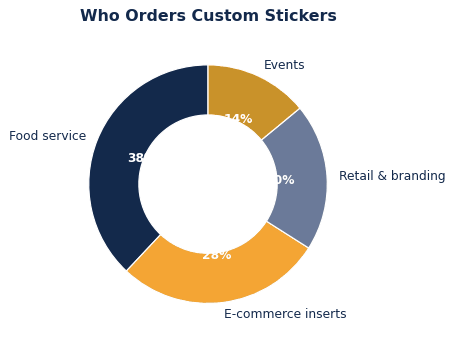
    The common ways brands put custom stickers to work.
    The common ways brands put custom stickers to work.

    Most orders lean toward one primary job with a secondary benefit — a shipping-focused stickers that also brands the unboxing, or a gift-focused one that also protects. Naming your primary use keeps the order focused and the spec appropriate.

    Use case What it needs
    Food service branded, food-safe paper that dresses up a serve
    E-commerce inserts thank-you and instruction cards that build loyalty
    Retail & branding labels and wraps that reinforce the brand
    Events printed pieces that tie a theme together

    Matching material and size to the use

    Once the use is clear, the material and size follow. A protection-first job favors a durable, well-fitted build; a presentation-first job favors a premium material and a clean print; a promotion-first job favors a cost-effective option you can order in volume. Sizing to the product with a small margin keeps the stickers looking intentional and performing its job.

    If a single order serves more than one use, spec to the most demanding one so the stickers performs everywhere. It is easier to use a slightly sturdier or more premium stickers across the board than to discover a bargain option falls short for your most important use case.

    Branding for the impression you want

    Decoration should reinforce the impression the use calls for. Digital and offset printing reproduce full-color art crisply, with spot colors and foil available for a premium touch. For a premium or gift use, lean on finishes and restraint; for high-volume promotion, prioritize a bold, legible logo that reads at a glance and reproduces affordably at scale. Keep branding consistent with the rest of your packaging or merch so everything reads as one system.

    The most-requested options below reflect what buyers reach for most, and they are a useful starting menu when you brief your order. Whatever you choose, approve a proof so the finished custom stickers match the impression you intended.
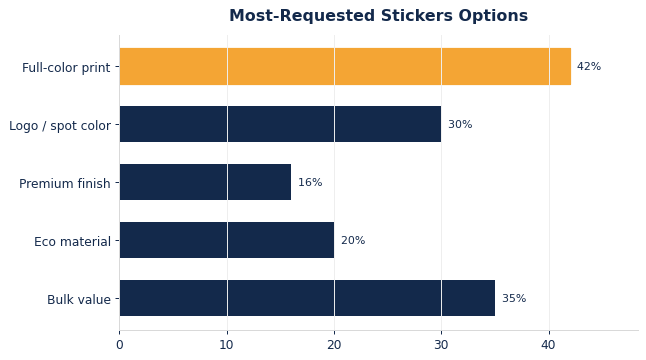
    The options buyers request most on custom stickers.
    The options buyers request most on custom stickers.

    Getting the size and details right

    Even with the use and material decided, the details are what make custom stickers feel finished. Confirm the size and weight against the product with a small margin, check the print area for your chosen size so the logo sits cleanly, and decide on any finishing touches before you brief the order. These small confirmations up front are what separate a stickers that looks intentional from one that looks close-enough.

    A sample or proof is the cheapest insurance you can buy on a stickers order. A physical sample lets you judge the material and print in hand, while a digital proof confirms artwork, color, and size and weight before the full run. Spending a few minutes here prevents the far larger cost of reworking a finished order of custom stickers that missed on a detail.

    Ordering: quantities, lead time, and reorders

    A smooth stickers order comes down to a few basics: order for real demand plus a small overage, send print-ready artwork early, and confirm lead time against any deadline so production and shipping fit your timeline. Per-unit cost drops with volume, so consolidating a season’s needs into one run is usually more efficient than repeated small orders.

    Keep your approved artwork and spec on file so reorders are a quick repeat rather than a fresh setup each time — consistency across runs keeps your brand looking deliberate.

    Coordinating with the rest of your brand

    Custom stickers rarely stand alone; they sit alongside your other packaging, print, or merch, so coordinating them strengthens the whole brand. Carrying the same logo, colors, and tone across your stickers and your other pieces makes everything read as one deliberate system rather than a set of one-off orders. That consistency is what makes a brand feel established, and it costs nothing extra to plan.

    Coordination also simplifies buying over time. Standardizing on a material, size, and decoration you are happy with turns future orders into simple repeats, and it keeps every batch matching the last. A little upfront alignment pays back every time you reorder custom stickers.

    Frequently asked questions about custom stickers

    What are custom stickers used for?

    Custom stickers serve a mix of protection, presentation, and promotion across food service, e-commerce inserts, retail & branding, and events. Most orders lean toward one primary job with a secondary benefit, so naming your main use is the first step in speccing the right stickers.

    How do I match custom stickers to my use?

    Let the use drive the spec: durable and well-fitted for protection, premium and clean for presentation, cost-effective and bold for promotion. If one order serves several uses, spec to the most demanding one so the stickers performs everywhere.

    How should I brand custom stickers?

    Digital and offset printing reproduce full-color art crisply, with spot colors and foil available for a premium touch. Choose finishes and restraint for premium or gift uses, and a bold, legible logo for high-volume promotion, keeping the branding consistent with your other packaging or merch so it all reads as one system.

    How far ahead should I order custom stickers?

    Order for real demand plus a small overage, send print-ready artwork early, and confirm lead time against any deadline so production and shipping fit your timeline. Consolidating a season’s needs into one run is usually more efficient than repeated small orders.

    Can I reorder easily?

    Yes. Keeping your approved artwork and spec on file makes reorders a quick repeat rather than a fresh setup, and it keeps every batch of custom stickers matching the last for a consistent brand look.

    Do I need a sample before ordering custom stickers?

    A sample is worth it for a first order or a new material, since judging feel and print in hand removes the guesswork. For a straightforward reorder of custom stickers you have bought before, a digital proof confirming artwork and size and weight is usually enough.

    Match the stickers to the job, spec it deliberately, and approve a proof, and your order will do exactly what you needed. For the full material and sizing breakdown, see our companion guide, our Custom Stickers: Materials, Sizing & Branding Guide, and browse our our shop to get started.

    Not sure which custom stickers fit your use?

    Tell us how you’ll use them and we’ll match the material, size, and branding to the job.
    Get a Quote

  • Custom Stickers: Materials, Sizing & Branding Guide

    Custom Stickers: Materials, Sizing & Branding Guide

    Custom Stickers: A Materials, Sizing, and Branding Guide

    Getting custom stickers right comes down to three decisions: the material, the size or spec, and how you brand them. Make those well and you end up with custom stickers that protect and present your product, reinforce your brand, and land on budget. This guide walks through the material options, how to size and spec your order, and how to decorate custom stickers so they do real work for your brand rather than just checking a box.

    Whether you are ordering your first run or reordering at scale, the same fundamentals apply. Choosing custom stickers deliberately — material to job, size to product, decoration to brand — is what separates an order you are proud of from one you settle for.

    Why custom stickers matter for your brand

    Custom stickers are more than a commodity; they are a touchpoint brands experience directly. A well-chosen, well-branded option signals quality and attention to detail, while a generic one quietly undercuts an otherwise strong product. Because custom stickers are seen and handled, they carry your brand into the world every time they are used.

    That visibility is exactly why it pays to spec custom stickers intentionally. The material sets the feel, the size sets the fit and cost, and the decoration sets the impression — and getting all three aligned turns a functional item into a genuine brand asset.

    Materials and options compared

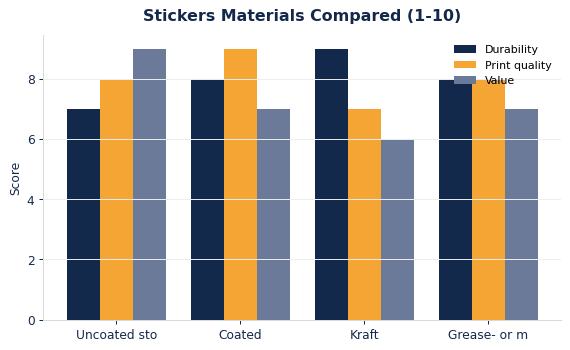
    The common materials for custom stickers each trade off durability, print quality, and cost: uncoated stock, coated / gloss stock, kraft / recycled, and grease- or moisture-resistant. The right pick depends on how the stickers will be used, the look you want, and your budget. The chart and table below compare the main options so you can match material to job.

    How common stickers materials compare on durability, print quality, and value.
    How common stickers materials compare on durability, print quality, and value.

    As a rule of thumb, choose a recyclable or natural material when eco positioning matters, a coated or laminated option when you want vivid full-color print, and a premium build when the stickers is part of a gift or high-end presentation. When in doubt, request a sample so you can judge feel and print before committing to a full run.

    Material / option Best for
    Uncoated stock natural, writable surface with a matte look
    Coated / gloss stock vivid color and a polished finish
    Kraft / recycled eco-forward, warm natural tone
    Grease- or moisture-resistant food-safe performance where needed

    Sizing and specs

    Sizing is where many stickers orders go wrong, so measure before you order. Custom stickers typically range from a small insert card up to a full wrap or liner sheet, and the right size and weight depends on the product or use they serve. Too small and the fit is tight or the product is exposed; too large and you pay for material you do not need and lose a clean, intentional look.

    When a measurement falls between standard options, size to the product with a small margin rather than guessing. Confirming the size and weight on a proof or sample before a large run prevents the costly mistake of a full order that does not fit, which is far more expensive to fix than a five-minute check up front.

    Branding and decoration

    Decoration is what turns a plain stickers into a branded one. Digital and offset printing reproduce full-color art crisply, with spot colors and foil available for a premium touch. Match the method to your artwork and budget: simple logos reproduce cleanly and cheaply, while detailed, full-color designs shine with the right process on the right material. Keep the artwork vector where possible and confirm the print area for your chosen size.

    Restraint usually reads as premium. A clean logo, one or two brand colors, and quality material almost always look more considered than a busy, over-printed design. Approving a proof before the run protects both the look and the budget, especially on a large order of custom stickers.

    Ordering and budget

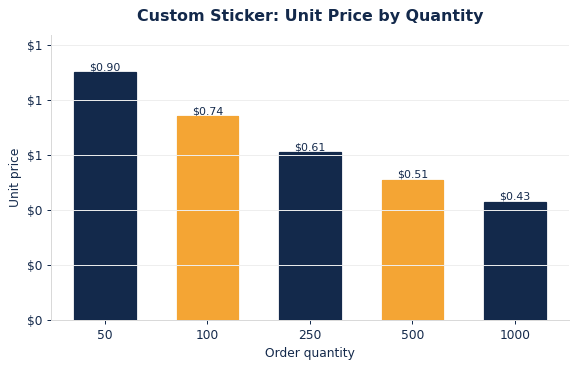
    Per-unit cost on custom stickers falls steadily with volume as setup amortizes across more pieces, so ordering for real demand rather than a token first batch is usually the efficient move. The curve below shows how pricing typically improves with quantity, which helps you plan an order that balances cash and cost.

    Typical per-unit stickers pricing as order quantity increases.
    Typical per-unit stickers pricing as order quantity increases.
    Ordering for a recurring need? A single larger run lowers the unit cost and keeps your branding consistent, while a small overage covers reorders and the occasional damaged piece without a rush order.

    Common mistakes to avoid

    A few avoidable missteps account for most disappointing stickers orders. Ordering before measuring is the biggest, followed by choosing a material for price alone without considering how the stickers will actually be used, and skipping the proof on a large run. Each is easy to prevent with a few minutes of planning, and each is expensive to fix once a full order is produced.

    The other common trap is over-designing the artwork. Cramming in too many colors, effects, or details can muddy the print and raise the cost, especially on textured or recycled materials. Simplifying the design to a clean, legible mark almost always improves both the look and the price of your custom stickers.

    Frequently asked questions about custom stickers

    What material is best for custom stickers?

    It depends on the use: choose a recyclable or natural material for eco positioning, a coated or laminated option for vivid full-color print, and a premium build for gifting or high-end presentation. Request a sample to judge feel and print before a full run of custom stickers.

    How do I choose the right size?

    Measure the product or use the stickers serves, then size to it with a small margin so the fit is clean without wasting material. When a measurement falls between standard options, size up slightly and confirm the size and weight on a proof before ordering in volume.

    How are custom stickers branded?

    Digital and offset printing reproduce full-color art crisply, with spot colors and foil available for a premium touch. Match the method to your artwork and budget, keep the art vector where possible, confirm the print area for your size, and approve a proof so the finished custom stickers match your intent.

    How does pricing work, and is there a minimum?

    Per-unit cost drops with quantity as setup amortizes across the run, so larger orders are more cost-effective. Order for real demand plus a small overage rather than a token batch, and consolidate recurring needs into one run for the best price.

    Can I get a sample or proof before ordering?

    Yes, and it is strongly recommended. A physical sample lets you judge material and print, and a digital or physical proof confirms your artwork, color, and size and weight before a full run — a small step that prevents a costly mistake on a large order.

    What do you need to quote custom stickers?

    To quote accurately we need the size and weight or the product they serve, the quantity, your material preference, and your artwork or a description of the branding. With those details we can recommend the right material and size and give you pricing for the run, and a proof follows once the order is confirmed.

    Whatever you order, send vector artwork, confirm material and size and weight, and approve a proof before production. For help matching custom stickers to a specific use, see our companion guide, our How to Choose Custom Stickers for Your Brand, and explore our our shop to start your order.

    Ready to order custom stickers?

    Tell us your product, quantity, and branding and we’ll match the material, size, and decoration for you.

    Get a Quote

  • How Many Custom Stickers Should You Order? — Custom Stickers HQ

    HomeBlog › How Many Custom Stickers Should You Order?

    Ordering

    How Many Custom Stickers Should You Order?

    07/01/2026

    Ordering custom stickers for the first time, most people either overbuy on a design they’ll tweak or underbuy and miss the volume price — and both cost money. Because printed stickers carry a setup cost, the per-unit price drops sharply with quantity, so the right order size is as much about economics as it is about how many you’ll actually hand out.

    Here’s how to size an order once you separate your program into its real use cases.

    First drop: order enough to hit a real tier

    For a first run, don’t order the bare minimum — setup dominates at low volumes, so the per-sticker price at 100 can be several times the price at 1,000. If you’re confident in the design, ordering up one tier usually costs only marginally more total while cutting your per-unit cost dramatically. If the design might change, order a small proof run first, then scale.

    Events & swag: base it on foot traffic

    Estimate the people you’ll reach and plan for a high take rate — good stickers move fast. For a booth, budget one to two stickers or one sheet per expected visitor, and bring a buffer; running out on day one of a two-day event is the most common regret.

    Packaging: base it on order volume

    If stickers seal or label your shipments, tie the quantity to your weekly order count, order 8–12 weeks of stock, and reorder at about 3 weeks of cover. Because we keep your dieline on file, reprints are fast and match exactly.

    UseStarting quantityWhy
    Design finalOrder up a tier (often 1,000+)Setup cost dominates at low volume
    Design uncertainSmall proof run firstValidate before scaling
    Event / booth1–2 per expected visitorGood stickers have a high take rate
    Packaging8–12 weeks of order volumeReorder at ~3 weeks cover
    Key takeaway

    The single biggest lever on per-sticker cost is quantity: once your artwork is final, ordering up one tier usually pays for itself immediately.

    Tell us your design, size, and volume and we’ll show you exactly where the price tiers fall — with a free mockup, within one business day.

    More posts

  • Vinyl vs. Paper Stickers: Which Should You Choose? — Custom Stickers HQ

    HomeBlog › Vinyl vs. Paper Stickers: Which Should You Choose?

    Buyer Guides

    Vinyl vs. Paper Stickers: Which Should You Choose?

    06/17/2026

    The two big families of stickers are durable vinyl and coated or uncoated paper, and choosing between them comes down to one question: where will the sticker live? Get it right and your sticker looks great for years or costs pennies where it should; get it wrong and you either overpay for durability you don’t need or watch a paper sticker curl on a water bottle.

    Here’s how to decide by use, not by habit.

    Choose vinyl when it has to survive

    Vinyl is waterproof, scratch-resistant, and UV-stable, so it’s the right call for anything that will be handled, washed, or go outdoors — laptops, water bottles, cars, product labels that get wet, and merch people keep for years. It costs more per unit, but it’s the difference between a sticker that lasts and one that fails in a month.

    Choose paper when it lives indoors

    Coated and kraft paper stickers are cheaper and photograph with a warm, matte, hand-finished look, which is perfect for packaging seals, mailer closures, event handouts, and anything used once indoors. If the sticker’s job is done the moment the box is opened, paper is the smarter spend.

    A quick decision rule

    Ask whether the sticker will get wet or go outside. If yes, go vinyl. If it lives on a box, a card, or an indoor surface and is essentially single-use, go paper — and put the savings into ordering more of them.

    FactorVinylPaper / kraft
    DurabilityWaterproof, years outdoorIndoor, single-use
    LookGloss, matte, holographic, clearWarm matte, natural kraft
    CostHigher per unitLower per unit
    Best forMerch, labels, outdoorPackaging seals, handouts
    Key takeaway

    Rule of thumb: if it can get wet or go outside, choose vinyl. If it lives on a box indoors, paper is cheaper and looks warmer.

    Tell us where your sticker will live and we’ll recommend the right material and mock it up — free, within one business day.

    More posts

  • Die-Cut vs. Kiss-Cut: A Guide to Sticker Cuts — Custom Stickers HQ

    HomeBlog › Die-Cut vs. Kiss-Cut: A Guide to Sticker Cuts

    Design & Artwork

    Die-Cut vs. Kiss-Cut: A Guide to Sticker Cuts

    06/03/2026

    Two words come up on every sticker quote — die-cut and kiss-cut — and they describe how the sticker is cut, which changes both how it looks and how you hand it out. Understanding the difference takes a minute and saves a reprint.

    Here’s what each cut does and when to choose it.

    Die-cut: the sticker is the shape

    A die-cut sticker is cut all the way through the material and the backing to the exact outline of your artwork, so the sticker itself is the shape of your logo with no visible border. It peels off on its own and is the premium, most-kept look — the default for individual logo and merch stickers.

    Kiss-cut: cut the top, keep the backing

    A kiss-cut only slices the sticker layer, leaving the backing sheet intact. That lets you put several stickers on one sheet, add a border or design around the sticker, and make peeling easy. It’s the format for sticker sheets, packs, and any handout where you want more than one sticker per piece.

    How to choose

    For a single, shaped logo sticker people put on a laptop or bottle, choose die-cut. For a set, a pack, a packaging insert, or anything where a backing and easy peel help, choose kiss-cut. Many brands order both — a die-cut hero and a kiss-cut sheet.

    CutLookBest for
    Die-cutSticker is the exact shape, no borderIndividual logo & merch stickers
    Kiss-cutSticker on an intact backingSheets, packs, packaging inserts
    Key takeaway

    Simple rule: one shaped sticker, choose die-cut; several stickers or an easy-peel handout, choose kiss-cut.

    Send your artwork and we’ll show you both cuts on a free mockup within one business day, so you can see the difference.

    More posts

  • Are Your Stickers Waterproof? A Guide to Durability & Lamination — Custom Stickers HQ

    HomeBlog › Are Your Stickers Waterproof? A Guide to Durability & Lamination

    Product & Care

    Are Your Stickers Waterproof? A Guide to Durability & Lamination

    05/20/2026

    The most common sticker complaint is fading, curling, or peeling, and it almost always traces back to material and lamination. A waterproof, long-lasting sticker isn’t luck — it’s a spec, and it’s worth understanding before you order.

    Here’s what actually makes a sticker survive water, sun, and scuffing.

    Print + laminate = durable

    A durable sticker is UV-cured ink on a waterproof vinyl, sealed under a clear protective laminate. The laminate is the key: it shields the ink from water, abrasion, and UV, which is why a laminated vinyl sticker survives a dishwasher and an unlaminated paper one doesn’t. When durability matters, always spec a laminate.

    Outdoor life by material

    Standard durable vinyls are rated for roughly three to five years outdoors; premium cast vinyls and bumper-grade films push to five or six. Indoor-only paper and kraft stickers aren’t built to get wet — and that’s fine, because their job is usually done indoors.

    Spec it for the job

    For water bottles and dishwashers, ask for gloss-laminated vinyl. For cars and outdoors, ask for a heavy weatherproof vinyl and UV laminate. For packaging seals opened once, paper is fine. Tell us the environment and we’ll match the film and finish.

    UseMaterialOutdoor life
    Laptop / bottleLaminated vinylYears, dishwasher-safe
    Car / outdoorHeavy weatherproof vinyl4–6 years
    Packaging sealPaper / kraftIndoor, single-use
    Key takeaway

    Freshness of look is a feature: a laminated vinyl sticker that survives the dishwasher is worth far more than an unlaminated one that fades in a month.

    Tell us where your sticker will live and we’ll spec a waterproof material and finish — with a free mockup within one business day.

    More posts

  • Stickers as Marketing: The Cheapest Brand Impression — Custom Stickers HQ

    HomeBlog › Stickers as Marketing: The Cheapest Brand Impression

    Marketing

    Stickers as Marketing: The Cheapest Brand Impression

    05/06/2026

    Most advertising interrupts people. A sticker is the rare exception — an ad people choose to display, for free, for years. That’s what makes custom stickers one of the highest-return, lowest-cost brand tools available, if you make one people actually want.

    Here’s how to think about stickers as marketing, not just merch.

    The economics are unbeatable

    A good sticker costs a few cents to a dollar and, once stuck on a laptop, bottle, or bumper, delivers thousands of impressions over its life to everyone who sees it. Compared with the cost per impression of digital or print ads, a sticker someone displays for two years is almost free advertising — and it comes with an implicit endorsement.

    People only display stickers they like

    The catch is that no one displays a boring sticker. The design has to earn its place: a clean die-cut of a logo people are proud of, a clever line, a piece of art, or a premium holographic finish. Spend the effort on making it desirable, because a sticker in a drawer is worth nothing and a sticker on a laptop is worth years.

    Make them easy to give and get

    Put stickers where your audience already is — in every package, at every event, in an onboarding kit, or as a free add-on. The friction to take and stick a sticker is near zero, so the more places you offer them, the more brand surface you create.

    ChannelCost per impressionEndorsement
    Digital adOngoing, per viewNone
    Sticker on a laptopPennies, then years freeImplicit, by the owner
    Key takeaway

    A sticker is the only ad people pay you nothing to display for years — but only if the design is one they’re proud to stick.

    Tell us your brand and audience and we’ll design a sticker worth keeping — free mockup, within one business day.

    More posts

  • How to Set Up Sticker Artwork for Print — Custom Stickers HQ

    HomeBlog › How to Set Up Sticker Artwork for Print

    Design & Artwork

    How to Set Up Sticker Artwork for Print

    04/22/2026

    The difference between a crisp sticker and a fuzzy one is usually the file, not the printer. Setting up artwork correctly takes a few minutes and avoids a round of revisions — and if you’d rather not, our designers will handle it for you free.

    Here’s the short prepress checklist we use.

    Start with vector art

    Vector files (AI, EPS, SVG, or PDF) scale to any size with razor-sharp edges and give a clean die-cut line. If you only have a raster image, provide it at high resolution (300 DPI at final size) — or send whatever you have and we’ll recreate it print-ready at no charge.

    Add bleed and a safe margin

    Extend your background about an eighth of an inch past the cut edge (the bleed) so no white slivers show after cutting, and keep important text and logos a similar distance inside the edge (the safe margin) so nothing critical gets trimmed.

    Define the cut line

    For a die-cut or kiss-cut, include a separate cut path — a vector outline on its own layer or spot color — showing exactly where you want the sticker cut. If you’re not sure, we’ll draw the optimal cut line around your art and show it on the mockup for approval.

    ElementSpecWhy
    File typeVector (AI/EPS/SVG/PDF)Sharp at any size, clean cut
    Bleed~0.125 in past cutNo white edges after cutting
    Safe margin~0.125 in inside cutNothing important trimmed
    Cut lineSeparate vector pathPrecise die/kiss cut
    Key takeaway

    No print-ready file? Don’t worry about any of this — send what you have and our designers will set it up free before you approve the mockup.

    Send your artwork in any format and we’ll return a print-ready, proofed mockup within one business day — revisions always free.

    More posts