Category: Buying Guides

  • Custom Stickers for Trade Shows and Conferences: An Event Playbook

    Custom Stickers for Trade Shows and Conferences: An Event Playbook

    Published October 5, 2026. Last updated October 5, 2026.

    Custom stickers are one of the easiest booth giveaways to get right at a trade show or conference: they are light to ship, cheap to carry, and they end up on laptops long after the event. Custom Stickers HQ prints die-cut, kiss-cut, holographic, clear and kraft stickers from a minimum of 12, with a free mockup within 24 hours.

    Key facts
    • Minimum order is 12 stickers per design
    • Free digital mockup within 24 hours, unlimited free revisions
    • Standard turnaround is about 2 weeks; faster options with express shipping
    • Die-cut vinyl, kiss-cut sheets, holographic, clear and kraft styles available
    • Pay nothing until you approve the design

    Why do custom stickers work so well as trade show giveaways?

    Custom stickers work as trade show giveaways because attendees actually keep them. A pen gets lost and a brochure gets recycled at the hotel, but a well-designed sticker goes straight onto a laptop lid, a water bottle or a notebook that travels back to the office. That turns one booth conversation into months of passive brand exposure.

    Stickers also solve the practical headaches of event logistics. They pack flat, so a few boxes fit in a carry-on or a booth crate with no extra freight. They need no assembly, no batteries and no sizing. Your booth staff can hand one over in a second, tuck a few into a swag bag, or drop a stack on a table without worrying about theft or breakage.

    Finally, stickers are a low-pressure way to open a conversation. Offering a sticker is easier than asking a stranger for their badge scan, and a striking design on the table pulls people in on its own. Many exhibitors find that a clever holographic or die-cut sticker becomes the thing attendees mention when they tell a colleague to visit the booth.

    Which sticker styles should you bring to a conference booth?

    The best sticker style for a conference booth depends on what you want the sticker to do after the show. Most exhibitors bring one hero sticker for the general crowd and one or two specialty designs for qualified leads or VIP meetings. The table below matches each style from Custom Stickers HQ to a typical booth role.

    Sticker styleBest booth roleWhy it works
    Die-cut vinylHero giveaway for every visitorCut to the shape of your logo or mascot, durable enough for laptops and bottles
    HolographicPremium reward for demos or scansShifts color under booth lighting, so people ask for it by name
    Kiss-cut sheetsSwag bags and developer or product teamsSeveral designs on one sheet, easy to slide into a bag or folder
    Clear vinylPartner and sponsor brandingLogo appears printed directly on glass, laptops or packaging
    Eco kraft and paperSustainability-focused showsNatural paper look that fits a low-waste booth story

    If you only order one design, choose die-cut vinyl. That style gives the widest appeal, survives being tossed in a bag, and shows your brand shape clearly from across an aisle.
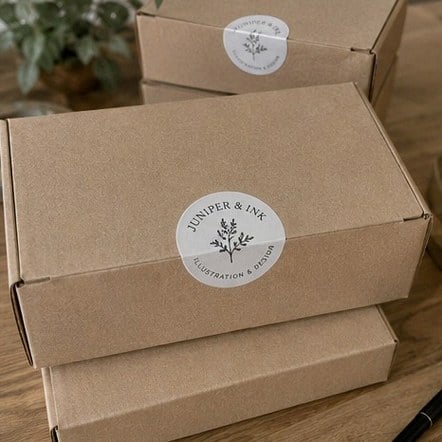
     - one of the custom stickers styles from Custom Stickers HQ
    Custom stickers from Custom Stickers HQ.

    How far ahead should you order custom stickers for a trade show?

    Order custom stickers for a trade show well before you need them at the booth, with a comfortable margin beyond the production time. Standard turnaround at Custom Stickers HQ is about 2 weeks after you approve the proof, and you want a buffer for artwork changes, internal sign-off and shipping to the venue or advance warehouse.

    Work backward from the date the stickers must be in hand, not from the opening day of the show. Many venues require booth materials to arrive at an advance warehouse days before setup, and that deadline is the real one.

    1. Lock the event date and the materials deadline. Check the exhibitor manual for advance warehouse cutoffs.
    2. Send your artwork and request a quote. Custom Stickers HQ returns a free mockup within 24 hours.
    3. Gather internal approvals. Revisions are free and unlimited, so use them to get marketing and leadership aligned.
    4. Approve the proof. Production starts only after you approve, and you pay nothing until then.
    5. Allow about 2 weeks for production and delivery, or ask about express shipping if the date is tight.

    If you attend several shows a season, order for the whole calendar at once and stage reorders between events rather than rushing before each one.

    What should a trade show sticker design include?

    A trade show sticker design should do one job at a glance: make people want to keep it. That usually means a bold shape, a short message, and branding that reads clearly from arm’s length. A dense sticker crammed with your tagline, website and product list tends to stay in the bag.

    • Lead with a shape. Die-cut outlines of your logo, mascot or product are more collectible than a plain rectangle.
    • Keep text short. A handle, a short phrase or an inside joke from your industry beats a full sentence.
    • Use the event. A limited design tied to the show name or city gives attendees a reason to collect it.
    • Plan contrast. Booth halls are bright and busy, so strong color contrast helps the design pop on the table.
    • Add a path back to you. A small URL or QR code on a kiss-cut sheet border works better than squeezing it into the main design.

    Send vector artwork where you can. The Custom Stickers HQ team checks every file during the free mockup step and flags thin lines, low resolution or tight cut paths before anything prints, so problems are solved on screen rather than on the show floor.

    How do you use stickers to drive booth traffic and capture leads?

    Use stickers to drive booth traffic by giving them a role in the visit instead of leaving a pile on the table. A tiered approach works well: a standard die-cut sticker for anyone who stops by, and a premium holographic or limited design for people who sit through a demo, book a meeting or let you scan their badge.

    Some ideas that exhibitors use with custom stickers:

    • Collect the set. Print a small series and give one per interaction, so returning visitors come back for the rest.
    • Demo reward. Hand the holographic design only after a product walkthrough.
    • Social prompt. Invite people to post their laptop with your sticker and tag your brand.
    • Partner bundles. Swap kiss-cut sheets with co-exhibitors or sponsors to reach each other’s visitors.
    • Post-show follow-up. Mail a sticker sheet with your thank-you note to the leads you scanned.

    Because the minimum order is 12, you can afford to make a small run of a special design for VIP meetings alongside your main booth sticker, without committing to a large quantity of something experimental.

    How many conference stickers should you bring?

    The right number of conference stickers depends on expected booth traffic, how many designs you hand out, and whether stickers also go into official swag bags. Start with the organizer’s attendance estimate and your own scan counts from past shows, then decide what share of visitors will receive each design.

    Plan generously on the hero sticker, because running out on the second morning of a show is a real cost. Plan tighter on the premium design, since scarcity is part of its appeal. Leftover die-cut vinyl stickers store well in a cool, dry place and work for the next event, sales kits or customer orders, so modest overage is rarely wasted.

    For quantity guidance in more depth, the existing Custom Stickers HQ guide on how many stickers to order walks through spares and reorders. When you request a quote, tell the team how many shows the order should cover, and they can suggest how to split the run across designs.

    What are the most common mistakes with trade show stickers?

    The most common mistakes with trade show stickers are ordering too late, choosing a design that only makes sense to your own team, and shipping to the wrong address. Each one is easy to avoid with a little planning.

    • Ordering after the advance warehouse deadline. Count backward from the materials cutoff, not show day.
    • Reusing a business card layout. A sticker needs a shape and a hook, not contact details.
    • Skipping the proof review. Check the mockup at actual size on screen and ask a colleague outside marketing whether they would stick it on their laptop.
    • Bringing one design to every audience. A developer conference and a retail buyer show reward different looks.
    • Packing stickers deep in the crate. Keep a starter supply in a carry-on in case freight is delayed.

    Most of these are caught during the free mockup and revision stage, which is why the Custom Stickers HQ process puts approval before payment and production.

    Frequently asked questions

    Can I order a different sticker design for each trade show we attend?

    Yes, custom stickers can be designed separately for every trade show on your calendar. Custom Stickers HQ applies the minimum of 12 per design, so a small limited run tied to one event name or city is practical. Each design gets its own free mockup within 24 hours, and you can approve them together or one at a time as each show approaches.

    Which sticker style stands out best under bright exhibition hall lighting?

    Holographic stickers usually stand out most under bright exhibition hall lighting, because the surface shifts color as people walk past the table. Die-cut vinyl with strong color contrast is the next best choice for a busy aisle. If you want both reach and wow factor, pair a die-cut hero design for everyone with a holographic version reserved for demos or meetings.

    Can conference stickers be shipped straight to the venue or advance warehouse?

    Conference stickers can be shipped to whatever address you provide, including a venue or an advance warehouse. Check your exhibitor manual for the exact labeling format and receiving dates, then share those details when you approve the proof. Custom Stickers HQ recommends planning delivery for before the warehouse cutoff, since late freight is a common cause of empty booth tables.

    Should trade show stickers include a QR code?

    Trade show stickers can include a QR code, but the code works best on a kiss-cut sheet border or a larger rectangle rather than squeezed into a small die-cut shape. Keep enough quiet space around the code so phones can read it. The free mockup lets you check placement and size before anything prints, so you can test scanning from the proof on screen.

    Are stickers a good fit for a sustainability-themed conference booth?

    Stickers made on eco kraft or paper stock suit a sustainability-themed conference booth well, because the natural texture matches a low-waste message. Custom Stickers HQ offers kraft and paper options alongside vinyl. Paper stickers are best for notebooks, packaging and indoor use, while vinyl remains the stronger option if attendees will put the sticker on water bottles or outdoor gear.

    How do kiss-cut sticker sheets work inside conference swag bags?

    Kiss-cut sticker sheets work well in conference swag bags because several designs sit on one flat backing that slides in next to brochures without bending. Attendees peel individual pieces off later. A sheet also leaves room for a short message, a website or a QR code on the border, which turns the giveaway into a light piece of follow-up marketing.

    Can we put a sponsor or partner logo on our event stickers?

    Event stickers can carry a sponsor or partner logo alongside your own, provided you have permission to use the partner artwork. Clear vinyl is a popular choice for co-branded designs because both logos appear printed directly onto the surface. Send each logo file with your request, and the Custom Stickers HQ mockup will show how the two brands balance before approval.

    What is the best way to store leftover stickers between trade shows?

    Leftover stickers keep best stored flat in a cool, dry place away from direct sunlight, ideally in their original box or a sealed bag. Vinyl stickers hold up well between events, so a modest overage from one trade show can serve the next one, sales kits or customer orders. Avoid hot vehicles and humid storage units, which can affect the adhesive over time.

    How can booth staff hand out stickers without the table getting picked clean?

    Booth staff can keep stickers from disappearing by displaying a small sample stack and keeping the rest behind the counter. Hand the standard die-cut design to anyone who stops, and reserve premium designs for demos, meetings or badge scans. Custom Stickers HQ customers often use a numbered collectible series, which encourages attendees to return rather than grab a handful at once.

    Can I see a proof of my trade show sticker at actual size before production?

    Your trade show sticker proof arrives as a free digital mockup within 24 hours, and you can request it at the size you plan to print. Viewing the design at actual size on screen helps you judge whether text is readable and the cut line looks clean. Revisions are unlimited and free, and Custom Stickers HQ starts production only after you approve.

    Do stickers work for virtual or hybrid conference attendees too?

    Stickers work for virtual and hybrid conference attendees when you mail them as part of a welcome kit or post-event thank-you. A kiss-cut sheet fits easily into a standard envelope with a note, so remote participants get the same branded keepsake as people on the show floor. Plan the mailing list early so the order quantity covers both audiences.

    Get a free mockup for your stickers

    Send your logo or idea and the quantity you have in mind. Custom Stickers HQ returns a free mockup within 24 hours, you approve the design before anything is produced, and standard turnaround is about two weeks with faster options available. Get a custom quote.
  • Custom Stickers: Pricing, MOQs & Materials Compared (2026)

    Ordering custom stickers for the first time usually means running into a wall of options before you’ve even seen a price: die-cut or sheet, glossy or matte, 50 pieces or 1,000. The reassuring part is that pricing across the major sticker printers is fairly predictable once you know the pattern — cost per piece drops sharply once you clear the smallest quantity tier, and minimum orders are lower than most first-time buyers assume.

    This guide pulls current pricing, minimum order quantities, and turnaround times directly from the printers people actually use, so you can budget an order of custom stickers before uploading any artwork. It also covers which materials hold up outdoors and which lead times are realistic if you need stickers shipped before an event.

    Lowest minimum order
    10 stickers
    Price at 1,000 units
    $0.20/sticker
    Cast vinyl outdoor lifespan
    5-7 years
    Standard turnaround
    4 business days + 2-day ship

    Source: StickerGiant, CustomStickers.com, Sticker Mule, and Arnold Prints (accessed August 2026)

    How much do custom stickers cost?

    Custom sticker pricing follows a steep volume curve. Looking at 3-inch die-cut vinyl stickers, a 50-piece order runs about $19.99 shipped — roughly $0.40 per sticker. Bump that to 250 pieces and the listed price drops to around $69.99, or about $0.28 each. At 1,000 pieces, the same style runs close to $199, which works out to roughly $0.20 per sticker. The size and design complexity of your artwork still move the number around, but the shape of the curve holds: most of the per-unit savings show up between 50 and 250 units, then taper off as quantities climb further.

    Not every printer prices this way, though. StickerApp sets a dollar floor rather than a fixed piece count — its minimum order for die-cut stickers is $26 for glossy-coated white vinyl, and $28 for sheet stickers where you fill the sheet with as many stickers as fit. That structure means a small, simple design can net you more pieces for the same $26 than a large, intricate one.

    Price per sticker falls from about $0.40 at 50 units to roughly $0.20 at 1,000 units.50 stickers: $0.40; 250 stickers: $0.28; 1,000 stickers: $0.2050 stickers$0.40250 stickers$0.281,000 stickers$0.20
    Price per sticker falls from about $0.40 at 50 units to roughly $0.20 at 1,000 units.Source: CustomStickers.com, 3-inch die-cut vinyl sticker listings (accessed August 2026)

    Minimum order quantities for custom stickers

    Low minimums are one of the bigger shifts in the sticker business over the last decade, and they make it realistic to order a small test batch of custom stickers before committing to a bulk run. Sticker Mule’s minimum sits at 10 stickers, and anything between 10 and 50 can be ordered in multiples of 10. StickerGiant matches that 10-piece minimum for its die-cut stickers, though roll labels on the same site carry a higher floor of 125 per design, since label printing runs on different equipment than die-cut sheet work.

    StickerApp, as noted above, doesn’t quote a piece-count minimum at all — it enforces a dollar minimum instead, which can work out to more or fewer physical stickers depending on size. If you’re testing a design before a bigger print run, comparing these structures matters more than comparing headline prices, since a $26 minimum on a large sticker might net you fewer pieces than a 10-piece minimum on a small one.

    Minimum order rules differ by whether a printer counts pieces or dollars.
    Printer Minimum order Standard lead time
    Sticker Mule 10 stickers (multiples of 10) 4 business days production + 2-day shipping
    StickerGiant 10 per design (die-cut); 125 for roll labels Rush ships 1 business day after proof approval
    StickerApp $26 minimum order value (die-cut vinyl) Quoted at checkout by size and quantity
    Minimum order rules differ by whether a printer counts pieces or dollars.Source: Sticker Mule, StickerGiant, and StickerApp support pages (accessed August 2026)

    Vinyl, holographic, or paper: which material to pick

    Material choice is where custom stickers earn or lose their durability, and it’s worth deciding this before you compare final prices, since finish options change the per-unit cost. The baseline for most orders is calendered vinyl with a gloss or matte laminate, which handles moisture, minor scratching, and everyday sun exposure. Cast vinyl costs more but is built for longer outdoor placement — car exteriors, laptops that travel outside, storefront windows.

    Vinyl for everyday durability

    Standard calendered vinyl with laminate is rated for roughly 2-5 years of outdoor use, which covers the large majority of orders — product packaging, laptop stickers, giveaway packs, and merch drops that won’t sit in direct sun for years on end. Premium cast vinyl, used when a sticker needs to survive extended outdoor exposure, is typically rated for 5-7 years. The laminate layer is doing most of the UV and scratch protection work in both cases, so skipping it to save a few cents per sticker is usually a false economy for anything that leaves an indoor desk.

    Holographic and specialty finishes

    Holographic stickers are printed on the same weatherproof vinyl base but with an iridescent laminate that shifts color under light. They cost more per piece than a standard gloss finish and, at some printers, run on a longer production queue — around 7-10 business days versus a same-week turnaround for standard vinyl — because the specialty laminate stock isn’t kept in as deep a supply. If a launch date is firm, confirm the holographic-specific lead time separately from the standard quote.

    Lead times: standard production vs. rush

    Sticker Mule’s standard turnaround is 4 business days of production plus 2-day shipping for US orders. A $9 rush option shortens production to 3 days for orders under $500. Larger orders scale the other direction: production runs 4 business days for orders over $500, stretches to 7 business days above $5,000, and reaches 12 business days for orders over $10,000 — proof approval time isn’t included in any of those windows. Exact reorders skip the proofing step entirely, which trims 1-2 days off both standard and rush timelines.

    StickerGiant offers a dedicated rush printing tier that ships orders 1 business day after you approve the proof, which is faster than Sticker Mule’s rush option but still depends on how quickly you sign off on the design proof — that step is usually the biggest variable in how fast a sticker order actually lands.

    Sizing, shapes, and finish add-ons

    Custom sticker pricing scales with surface area, not just piece count, so a 4-inch design costs more per unit than the same design at 2 inches even at identical quantities. Die-cut stickers, trimmed to the exact outline of the artwork, generally cost a bit more than kiss-cut stickers, which are cut through the vinyl layer only and left on a rectangular backing — useful when you want a clean edge without paying the die-cut premium on every piece.

    Sheet stickers change the math again: instead of paying per individual sticker, you pay for a sheet and fit as many designs on it as space allows, which is often the cheapest route for multi-design orders like sticker packs. Whichever format you choose, get a physical proof or sample pack before committing to a full run — colors and adhesive strength both vary enough between printers that a screen preview isn’t a reliable stand-in.

    Frequently asked questions

    What’s the cheapest way to order custom stickers?

    Order the largest quantity you’ll realistically use. Per-sticker price drops from around $0.40 at 50 pieces to roughly $0.20 at 1,000 pieces for a standard 3-inch die-cut design, so batching designs into one larger order beats placing several small ones.

    How small can a custom sticker order be?

    Sticker Mule and StickerGiant both allow orders as small as 10 stickers per design. StickerApp instead sets a $26 minimum order value for die-cut vinyl, which may translate to more or fewer physical pieces depending on your sticker’s size.

    How long do custom stickers last outdoors?

    Standard calendered vinyl with laminate typically lasts 2-5 years outdoors. Premium cast vinyl, built for longer exposure, is usually rated for 5-7 years. Laminate is the main factor in UV and scratch resistance either way.

    What’s the difference between die-cut and kiss-cut stickers?

    Die-cut stickers are trimmed exactly to the shape of the design and typically cost a bit more per piece. Kiss-cut stickers are cut through the vinyl only, leaving them on a rectangular backing sheet, which is usually the cheaper option.

    Can I get custom stickers fast for an event?

    Yes. Sticker Mule offers a $9 rush option that cuts production to 3 business days for orders under $500, and StickerGiant’s rush tier ships 1 business day after you approve the design proof. Approving the proof quickly is usually the biggest factor in actual delivery speed.

    Are holographic stickers more expensive than standard vinyl?

    Yes, holographic stickers cost more per piece than standard gloss or matte vinyl because of the specialty laminate, and production can run 7-10 business days at some printers versus a faster standard turnaround.

    The bottom line

    The fastest way to avoid overpaying on a custom stickers order is to match the printer’s pricing structure to your actual run size: piece-count minimums like Sticker Mule’s and StickerGiant’s favor small test batches, while dollar-minimum pricing like StickerApp’s rewards compact designs. Either way, request a sample or physical proof before placing a bulk order — the price differences between vendors are real, but so are the differences in vinyl weight, adhesive strength, and print vibrancy that a spec sheet won’t show you.

    Once you’ve settled on material and size, lock in your quantity based on the volume discount curve rather than rounding down to save a few dollars up front — the per-sticker savings between 250 and 1,000 units are large enough to change which quantity actually makes sense for your budget.

  • Custom Stickers: Materials, Sizing & Branding Guide

    Custom Stickers: Materials, Sizing & Branding Guide

    Custom Stickers: A Materials, Sizing, and Branding Guide

    Getting custom stickers right comes down to three decisions: the material, the size or spec, and how you brand them. Make those well and you end up with custom stickers that protect and present your product, reinforce your brand, and land on budget. This guide walks through the material options, how to size and spec your order, and how to decorate custom stickers so they do real work for your brand rather than just checking a box.

    Whether you are ordering your first run or reordering at scale, the same fundamentals apply. Choosing custom stickers deliberately — material to job, size to product, decoration to brand — is what separates an order you are proud of from one you settle for.

    Why custom stickers matter for your brand

    Custom stickers are more than a commodity; they are a touchpoint brands experience directly. A well-chosen, well-branded option signals quality and attention to detail, while a generic one quietly undercuts an otherwise strong product. Because custom stickers are seen and handled, they carry your brand into the world every time they are used.

    That visibility is exactly why it pays to spec custom stickers intentionally. The material sets the feel, the size sets the fit and cost, and the decoration sets the impression — and getting all three aligned turns a functional item into a genuine brand asset.

    Materials and options compared

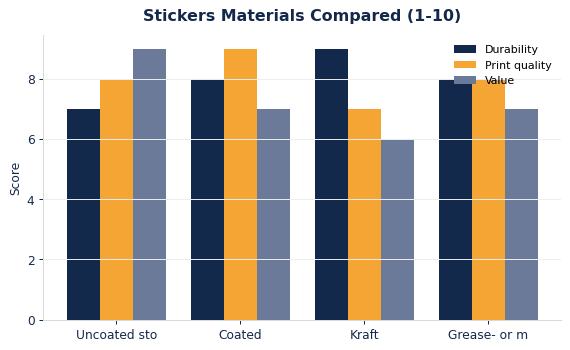
    The common materials for custom stickers each trade off durability, print quality, and cost: uncoated stock, coated / gloss stock, kraft / recycled, and grease- or moisture-resistant. The right pick depends on how the stickers will be used, the look you want, and your budget. The chart and table below compare the main options so you can match material to job.

    How common stickers materials compare on durability, print quality, and value.
    How common stickers materials compare on durability, print quality, and value.

    As a rule of thumb, choose a recyclable or natural material when eco positioning matters, a coated or laminated option when you want vivid full-color print, and a premium build when the stickers is part of a gift or high-end presentation. When in doubt, request a sample so you can judge feel and print before committing to a full run.

    Material / option Best for
    Uncoated stock natural, writable surface with a matte look
    Coated / gloss stock vivid color and a polished finish
    Kraft / recycled eco-forward, warm natural tone
    Grease- or moisture-resistant food-safe performance where needed

    Sizing and specs

    Sizing is where many stickers orders go wrong, so measure before you order. Custom stickers typically range from a small insert card up to a full wrap or liner sheet, and the right size and weight depends on the product or use they serve. Too small and the fit is tight or the product is exposed; too large and you pay for material you do not need and lose a clean, intentional look.

    When a measurement falls between standard options, size to the product with a small margin rather than guessing. Confirming the size and weight on a proof or sample before a large run prevents the costly mistake of a full order that does not fit, which is far more expensive to fix than a five-minute check up front.

    Branding and decoration

    Decoration is what turns a plain stickers into a branded one. Digital and offset printing reproduce full-color art crisply, with spot colors and foil available for a premium touch. Match the method to your artwork and budget: simple logos reproduce cleanly and cheaply, while detailed, full-color designs shine with the right process on the right material. Keep the artwork vector where possible and confirm the print area for your chosen size.

    Restraint usually reads as premium. A clean logo, one or two brand colors, and quality material almost always look more considered than a busy, over-printed design. Approving a proof before the run protects both the look and the budget, especially on a large order of custom stickers.

    Ordering and budget

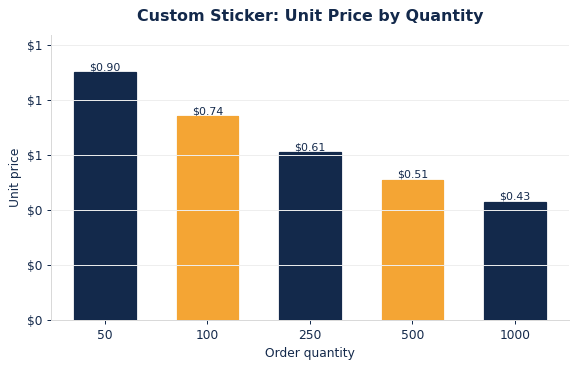
    Per-unit cost on custom stickers falls steadily with volume as setup amortizes across more pieces, so ordering for real demand rather than a token first batch is usually the efficient move. The curve below shows how pricing typically improves with quantity, which helps you plan an order that balances cash and cost.

    Typical per-unit stickers pricing as order quantity increases.
    Typical per-unit stickers pricing as order quantity increases.
    Ordering for a recurring need? A single larger run lowers the unit cost and keeps your branding consistent, while a small overage covers reorders and the occasional damaged piece without a rush order.

    Common mistakes to avoid

    A few avoidable missteps account for most disappointing stickers orders. Ordering before measuring is the biggest, followed by choosing a material for price alone without considering how the stickers will actually be used, and skipping the proof on a large run. Each is easy to prevent with a few minutes of planning, and each is expensive to fix once a full order is produced.

    The other common trap is over-designing the artwork. Cramming in too many colors, effects, or details can muddy the print and raise the cost, especially on textured or recycled materials. Simplifying the design to a clean, legible mark almost always improves both the look and the price of your custom stickers.

    Frequently asked questions about custom stickers

    What material is best for custom stickers?

    It depends on the use: choose a recyclable or natural material for eco positioning, a coated or laminated option for vivid full-color print, and a premium build for gifting or high-end presentation. Request a sample to judge feel and print before a full run of custom stickers.

    How do I choose the right size?

    Measure the product or use the stickers serves, then size to it with a small margin so the fit is clean without wasting material. When a measurement falls between standard options, size up slightly and confirm the size and weight on a proof before ordering in volume.

    How are custom stickers branded?

    Digital and offset printing reproduce full-color art crisply, with spot colors and foil available for a premium touch. Match the method to your artwork and budget, keep the art vector where possible, confirm the print area for your size, and approve a proof so the finished custom stickers match your intent.

    How does pricing work, and is there a minimum?

    Per-unit cost drops with quantity as setup amortizes across the run, so larger orders are more cost-effective. Order for real demand plus a small overage rather than a token batch, and consolidate recurring needs into one run for the best price.

    Can I get a sample or proof before ordering?

    Yes, and it is strongly recommended. A physical sample lets you judge material and print, and a digital or physical proof confirms your artwork, color, and size and weight before a full run — a small step that prevents a costly mistake on a large order.

    What do you need to quote custom stickers?

    To quote accurately we need the size and weight or the product they serve, the quantity, your material preference, and your artwork or a description of the branding. With those details we can recommend the right material and size and give you pricing for the run, and a proof follows once the order is confirmed.

    Whatever you order, send vector artwork, confirm material and size and weight, and approve a proof before production. For help matching custom stickers to a specific use, see our companion guide, our How to Choose Custom Stickers for Your Brand, and explore our our shop to start your order.

    Ready to order custom stickers?

    Tell us your product, quantity, and branding and we’ll match the material, size, and decoration for you.

    Get a Quote