Two stickers printed from the same artwork can feel like completely different products depending on the material and finish underneath. The film decides whether a design glows on a laptop lid, survives a summer on a truck bumper, or reads cleanly on a boutique jar. This guide walks through the specialty materials and finishes worth knowing, what each one actually does to your design, and where each earns its place.
The baseline: white vinyl and BOPP
White vinyl is the default for most custom stickers, and for good reason. It is durable, waterproof once laminated, and opaque, so your colors sit on a clean white base and print true. Its label-world cousin is BOPP, a polypropylene film that is waterproof, oil- and tear-resistant, and dishwasher-safe, which is why it dominates product labels and bottles. Both accept either matte or gloss lamination, and with a quality laminate a vinyl sticker commonly holds up outdoors for roughly three to five years. When color accuracy and toughness are the priority, this is where you start, and often where you should stay. Paper stock exists as a cheaper alternative, but it is really an indoor, short-life option for things like packaging seals and event handouts; the moment a sticker needs to survive water, sun, or handling, a vinyl or BOPP face is worth the small step up in cost.
Clear film and the white-underprint trick
Clear vinyl delivers the “no-label look”: the film effectively disappears and only your ink shows, which is ideal on glass, clear packaging, and glossy surfaces. There is one catch that surprises first-time buyers. Ink is translucent, so anything printed on clear film lets the surface behind it show through and looks washed out. Printers solve this with a white underprint, a layer of white ink laid down first behind the areas that need to be solid. The design implication is real: you decide which elements should be opaque, backed with white, and which should stay see-through. That choice, not just your color palette, is what defines how a clear sticker actually reads on the shelf. It also helps to favor bolder shapes and heavier line weights on clear stock, because thin, pale details with no white behind them tend to vanish against a busy background.
Effect films: holographic, metallic, and glitter
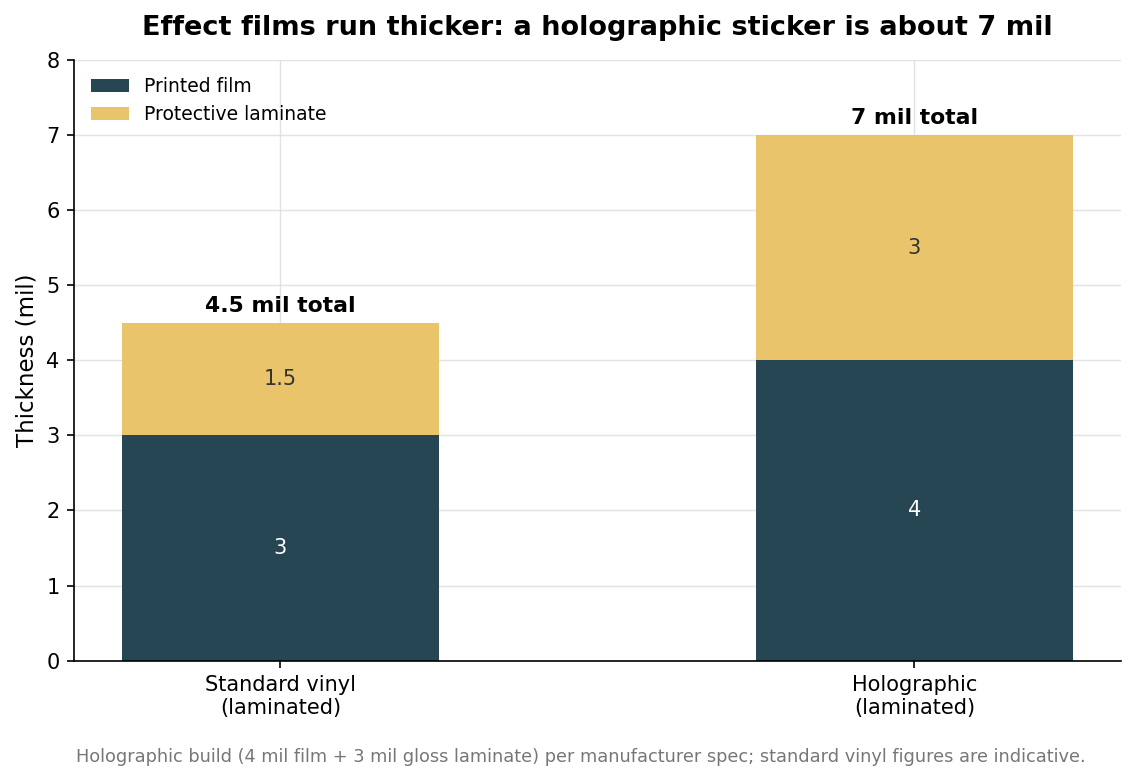
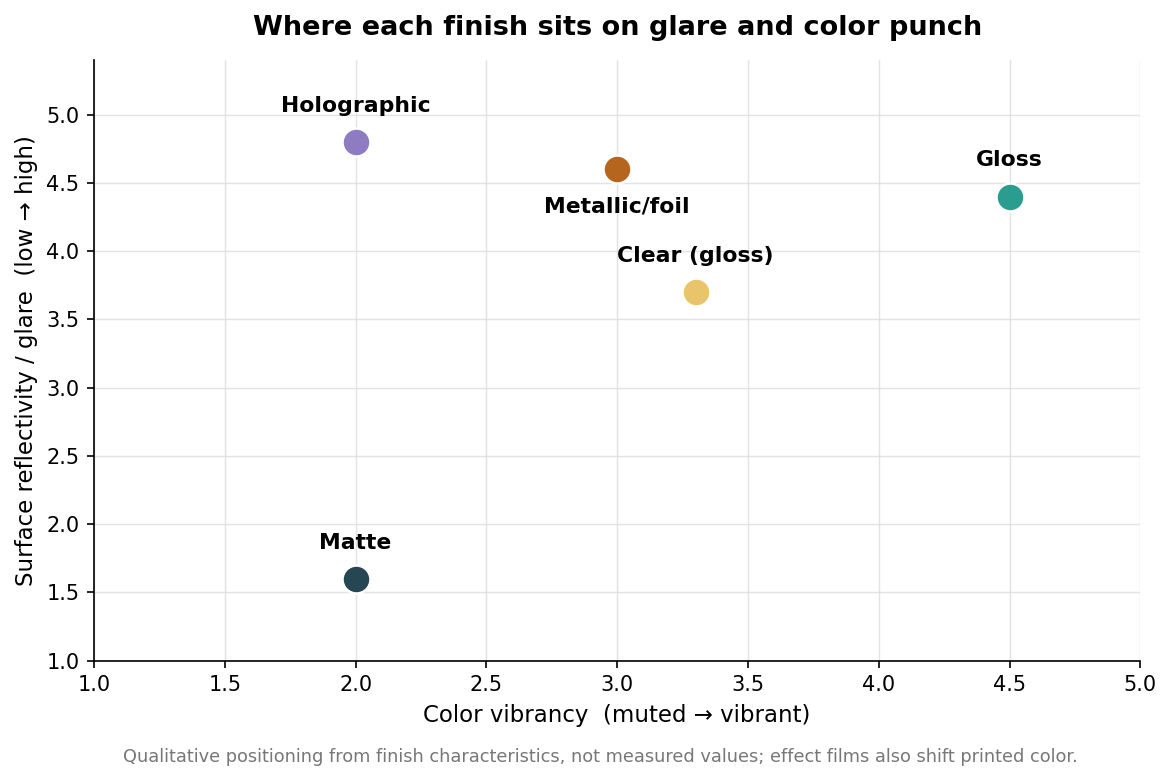
These are the attention-grabbers, and they follow their own rules. Holographic film has a gray-silver reflective base that throws a rainbow shimmer, sold in styles like standard iridescent, confetti, and cracked ice. Metallic and foil films give a mirror gold or silver, and glitter adds sparkle. They all share one tradeoff: the reflective base changes your colors. On holographic stock the darker silver base mutes and darkens printed inks, so the result will not match a white-vinyl proof, and if exact brand color matters these are simply the wrong pick. A white underprint can again carve out true-color areas beside the effect. The build is heftier, too: a common holographic construction is 4 mil of film plus a 3 mil gloss UV laminate, about 7 mil total. Durability is the other limit, because the rainbow effect degrades under constant UV, so effect films are rated best indoors, roughly two to five years and longest inside. Reach for them on merch, laptop stickers, and packaging accents, not a mailbox in full sun. Glitter finishes carry one extra caveat: the textured surface can trap grime and does not scan or photograph as cleanly, so keep barcodes, QR codes, and fine text off it and onto a smooth patch or a separate label.
Matte versus gloss lamination
Lamination is the clear layer on top, and choosing matte or gloss changes both the look and the lifespan. Gloss is shiny and reflective; it deepens contrast and makes colors pop, and it is UV-protected, which is exactly why gloss is the default for outdoor use and merchandise. Matte is non-reflective; it photographs and scans without glare, mutes colors for a refined and understated look, and feels premium in the hand, but standard matte laminate is typically not UV-protected, so matte stickers fade faster in direct sunlight. Both finishes are water- and weather-resistant, scratch-resistant, and dishwasher-safe. The short version: choose gloss for punch and outdoor life, matte for a soft aesthetic and glare-free labels, and lean gloss any time the sticker lives outside.
How to choose for your job
Work backward from where the sticker will live. For anything outdoors or on a vehicle, use laminated white or clear vinyl with a gloss finish so the UV protection is doing its job. For a boutique product label, matte-laminated white vinyl or BOPP gives the refined, glare-free look, while clear BOPP delivers the no-label effect on glass. For a merch drop or a laptop-lid giveaway where the wow factor is the whole point, holographic or metallic earns its keep, as long as you accept that colors shift and outdoor life is short. And any time you move to clear or an effect film, plan the white underprint at the design stage rather than discovering it on the proof. One last habit that saves reprints: on any unfamiliar material, order a small sample or a printed proof before committing to a full run, since holographic shimmer, a white underprint, and matte versus gloss all look different in hand than they do on a screen. Match the material to the environment and the finish to the feeling you want, and the same artwork will land the way you intended on every surface.
Leave a Reply