Almost every sticker decision people agonize over is about the side they can see: vinyl or paper, matte or gloss, die-cut or kiss-cut. The side that actually decides whether the sticker is still there next week is the adhesive on the back, and it is the one nobody specifies. Choose the wrong adhesive and a sharp-looking sticker curls off a water bottle in a month, tears the paint when a tenant peels it, or never grabs a plastic tub in the first place. The adhesive is invisible on a proof and rarely listed on a product page, so it pays to understand what is back there and how to match it to the job.
Permanent, removable, repositionable: a spectrum, not a switch
Adhesives sit on a spectrum that trades bond strength against clean removal, and picking a point on that spectrum is really the whole decision. Permanent adhesive is built to stay: it forms a high bond, and taking it off is destructive, often lifting paint or leaving a haze of residue behind. That is exactly what you want for product packaging, barcode labels, outdoor decals, and anything that should resist being peeled and moved. Removable adhesive forms a moderate bond and is designed to come off cleanly within a reasonable window, which makes it right for retail promotions, window signage, wall graphics, and seasonal or rental use. The catch worth knowing is that removable is time-limited, not time-proof; leave a removable sticker in the sun for long enough and the adhesive can cure into something closer to permanent, taking residue with it when it finally comes off. Repositionable, or ultra-removable, adhesive is lower tack still and lifts and resticks through many cycles, which suits reusable labels, planners, and positioning guides where the sticker is meant to move.
Rubber or acrylic: the choice under the choice
Underneath permanent-versus-removable sits a second decision about the adhesive chemistry, and it mostly comes down to acrylic versus rubber. Acrylic adhesives resist UV and solvents and age well, so they are the default for anything that lives outdoors, in a window, or through cold, though they can be slower to reach full grab. Rubber-based adhesives bring high immediate tack and stick to difficult surfaces that acrylics struggle with, including many plastics, silicone, and even Teflon, but they yellow and break down under UV and heat, which makes them an indoor or short-term choice. The quick rule: if it will see sunlight or weather, specify acrylic; if it has to grab an awkward plastic surface right now and stay indoors, a rubber-based high-tack adhesive is often the better tool.
The surface fights back: low surface energy
When a sticker refuses to hold, the problem is often not the adhesive’s strength but the surface’s surface energy. High-energy surfaces such as glass, aluminum, and painted steel let adhesive wet out and spread into full contact, so almost anything sticks to them. Low surface energy plastics do the opposite: polypropylene and HDPE, the materials most tubs, buckets, pails, and squeeze bottles are molded from, sit low on the scale and repel adhesive, so a standard permanent sticker beads up at the edges and lets go. Powder-coated metal and heavily textured surfaces create the same trouble by reducing real contact area. The chart below shows where common plastics fall against the rough threshold below which standard adhesives struggle.
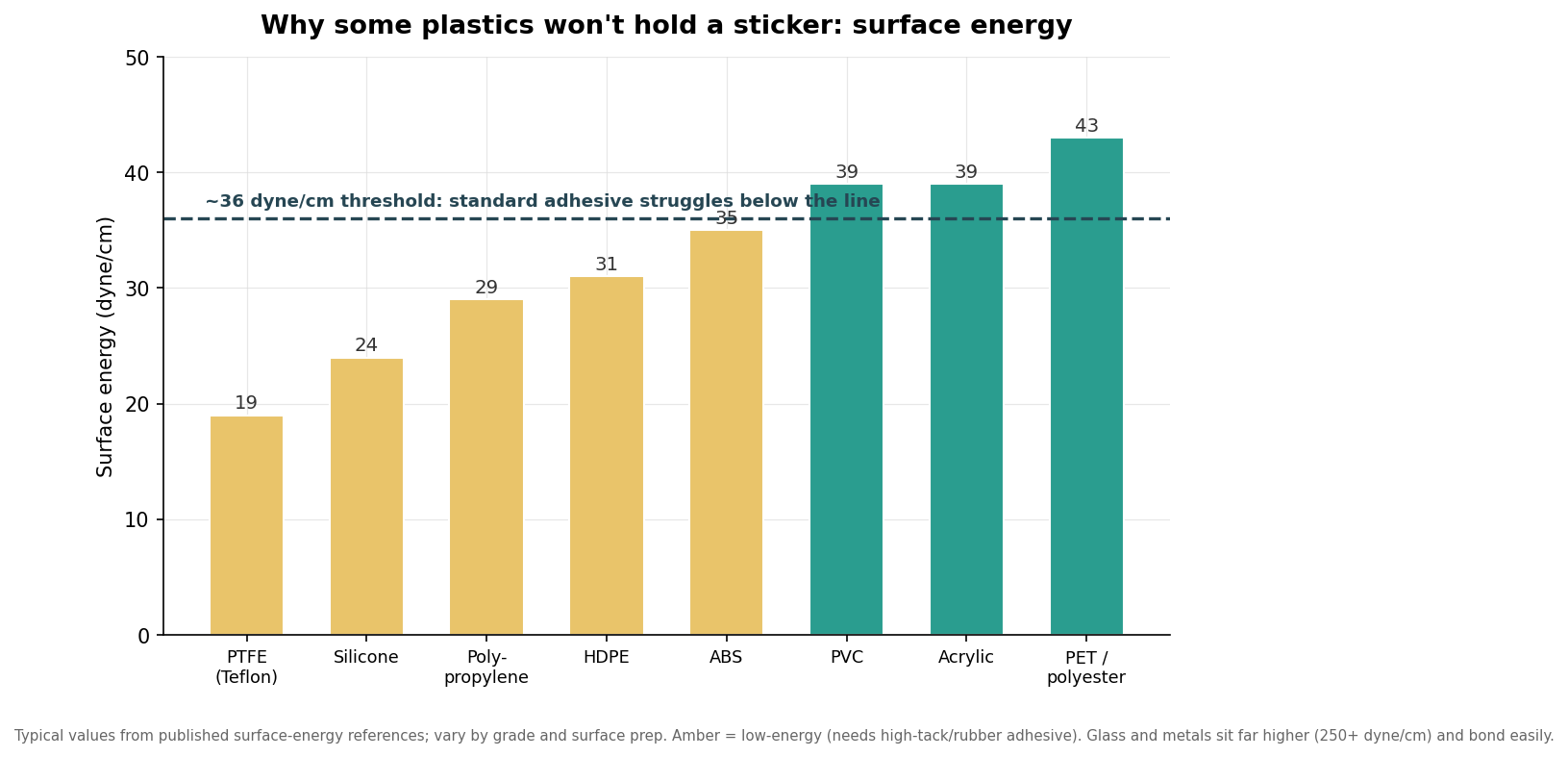
The fix for a stubborn plastic is to move up to a high-tack acrylic or a rubber-based adhesive formulated for low surface energy, frequently paired with a heavier adhesive coat weight so the glue can reach down into texture and around curves. If you are labeling plastic containers, this single specification matters more than the face material, the finish, or the print.
Temperature and dwell time: where field failures start
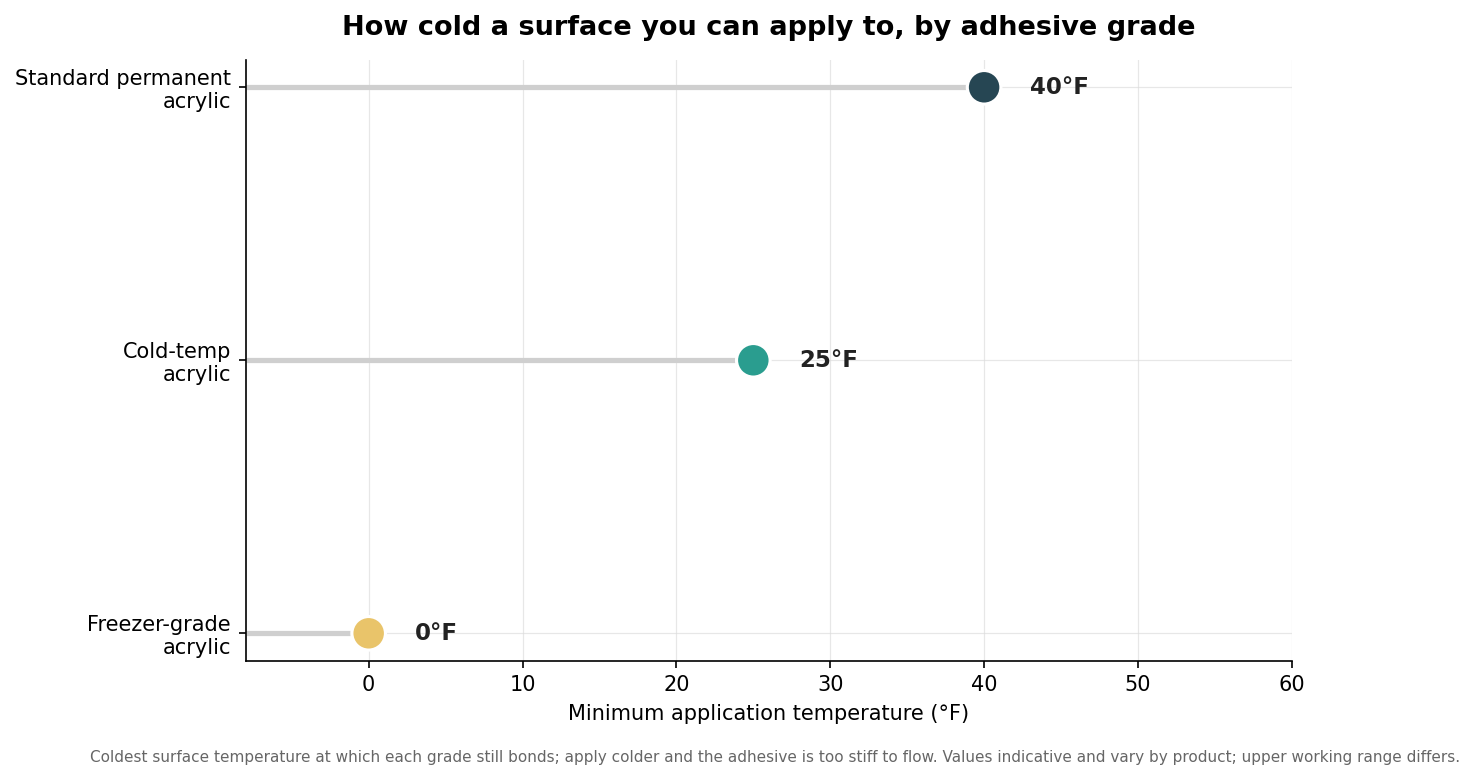
Two application details sink more stickers than the adhesive grade itself. The first is the temperature at the moment you apply. Standard permanent acrylic wants a surface roughly between 40 and 100 degrees Fahrenheit; press it onto something colder and the adhesive is too stiff to flow into the surface, so it never reaches full contact and peels at the first corner. Cold-temperature acrylics extend the floor down to around 25 degrees, and freezer-grade acrylics reach roughly zero for refrigerated and frozen goods, which is why cold-chain labels are a distinct product rather than a normal sticker applied in a cold room.
The second detail is patience. A pressure-sensitive adhesive is not at full strength the instant it touches down; it builds toward its ultimate bond over hours as it flows into the microtexture of the surface. A sticker that lifts slightly five minutes after application will often hold perfectly if it was pressed on firmly and then left undisturbed for a day. The practical habit that follows from both facts is simple: apply to a clean, dry, oil-free surface at a sensible temperature, press with real pressure across the whole sticker rather than a light pat, and give it time before you judge whether it worked.
Choosing the adhesive for your job
Put together, the decision is short once you name the surface, the environment, and how long the sticker needs to last. A product that ships and should resist tampering points to permanent acrylic. A window, wall, or promotional piece that has to come off later wants removable. Anything reusable or used as a positioning guide wants repositionable. A plastic tub, bucket, or squeeze bottle needs a high-tack acrylic or rubber adhesive with a heavier coat. Outdoor and long-life uses want acrylic, usually with a laminate over the face for UV and abrasion. Cold and freezer applications need the matching cold-temperature or freezer grade. When you are unsure, tell your printer three things in plain terms, the exact surface material, the environment it will live in, and how long it needs to stay put, and ask them to spec the adhesive and send a sample to test on the real surface first. Because the adhesive never shows up on a proof, a physical stick-and-peel test on the actual material is the only way to know before you commit to a full run.
Leave a Reply